
A great GPS watch doesn't have to cost a fortune. Many brands have spent the last few years quietly closing the gap between budget and flagship — and under £200, the options have never been better. Our picks are backed by hands-on testing and validated against the most trusted names in the space — Tom's Guide, Wareable, DC Rainmaker, and OutdoorGearLab. From solid starter to outright best buy — here's the list.
Some links in this post are affiliate links. If you buy through them we may earn a small commission — at no extra cost to you.
The Reliable Starter
Garmin Forerunner 55

Garmin Forerunner 55
The perfect first GPS running watch
The Rundown: The Forerunner 55 is the watch that gets thousands of people into GPS running every year — and for good reason. Accurate GPS, wrist-based heart rate, daily suggested workouts that adapt to your fitness, and 20 hours of GPS battery life, all tied together by Garmin's excellent Connect app. It's lightweight, comfortable, and genuinely easy to pick up and use from day one. The catch is that it launched in 2021 and the market has moved on. Newer watches now match or better it on almost every metric at a similar price point, and the single-band GPS and basic MIP display feel their age. If you find it at a steep discount it's still a solid buy — but the watches further up this list offer significantly more for your money.
Why Buy It? The most beginner-friendly GPS watch on the market, with Garmin's world-class ecosystem behind it.
✓ Pros
- Daily suggested workouts adapt to your fitness
- Best-in-class Garmin Connect app
- 20-hour GPS battery, 14 days smartwatch mode
- Incident detection and live tracking
✗ Cons
- Single-band GPS — struggles in city canyons
- Basic MIP display — functional, not inspiring
- No music or contactless payments
Best For: First-time GPS watch buyers who want the Garmin ecosystem at the lowest possible price
The Feature-Packed Wildcard
Suunto Run

Suunto Run
Dual-band GPS, AMOLED screen, and music at £199
The Rundown: On paper, the Suunto Run shouldn't exist at £199. Dual-band GPS, a vivid 1.32" AMOLED touchscreen, 4GB of offline music storage, 12 days of daily battery life, and a 36g body — it reads like a spec sheet from a watch costing twice the price. GPS accuracy is confirmed excellent by independent testing, on par with Suunto's pricier Race series. Where it falls short is in the ecosystem. Music requires manually loading MP3 files rather than streaming from Spotify, the companion app is smaller and less mature than Garmin's, and the software platform is still finding its feet. For raw hardware at this price it's unmatched — but the watches above it earn their spots through smarter training tools and more polished everyday experience.
Why Buy It? The most hardware per pound under £200 — dual-band GPS, AMOLED, and offline music in one package.
✓ Pros
- Dual-band GPS — exceptional accuracy in cities and under trees
- Vivid 1.32" AMOLED touchscreen
- 4GB offline music — run phone-free
- 36g, 12 days daily use, 20-hour GPS battery
✗ Cons
- Music is MP3 sideload only — no Spotify offline
- Smaller, less mature app ecosystem than Garmin
- New software platform — some feature gaps remain
Best For: Runners who want maximum hardware for their money and don't mind stepping outside the Garmin ecosystem
The Data Scientist's Choice
Polar Pacer Pro
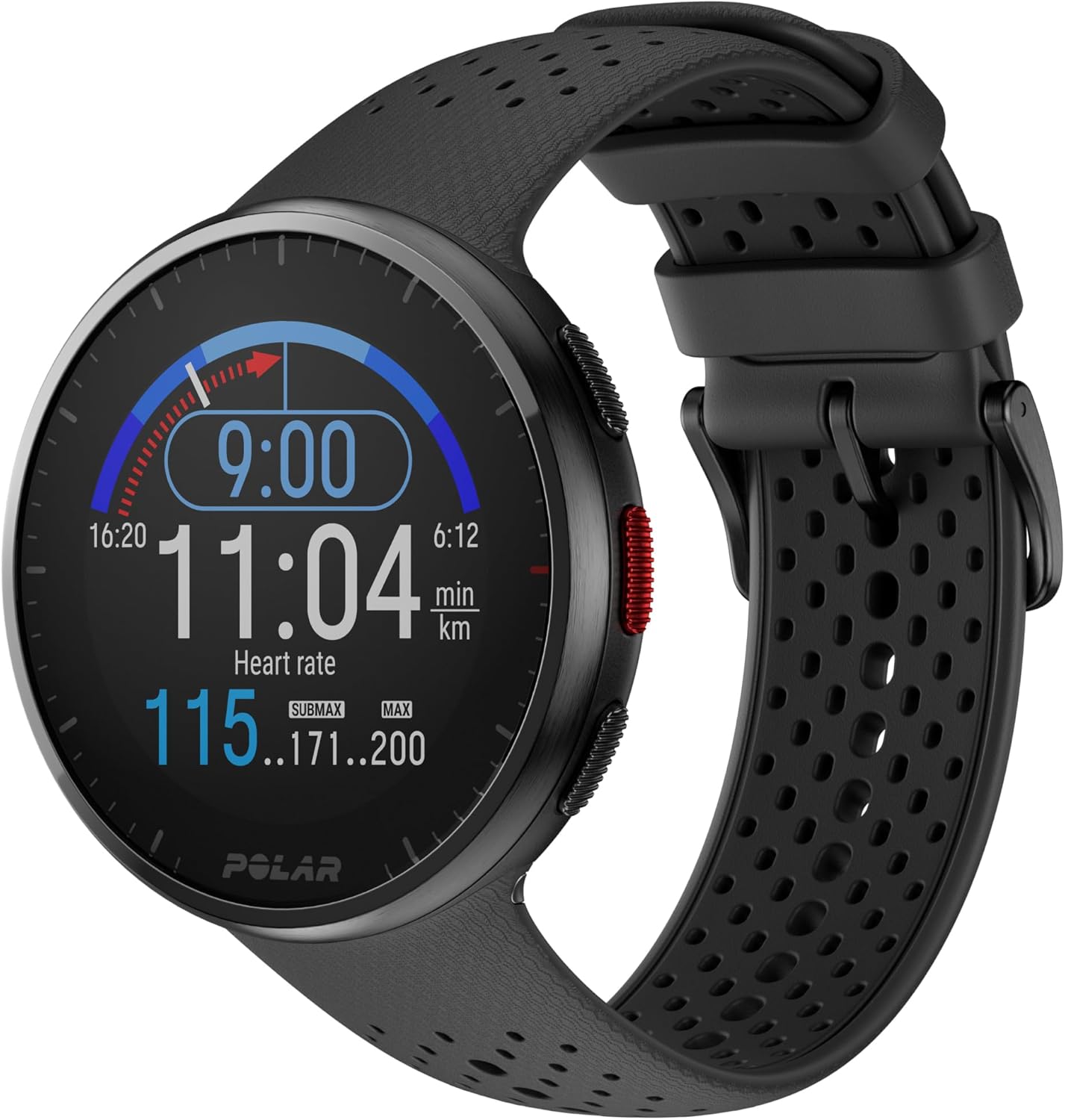
Polar Pacer Pro
Finnish precision engineering for the dedicated runner
The Rundown: Polar has been studying the science of heart rate since 1977, and the Pacer Pro is that expertise distilled into an accessible, everyday running watch. At just 41g and 11.5mm thin it's one of the slimmest options on this list, and the feature set is built specifically for runners who want to train intelligently rather than just log miles. The barometric altimeter delivers accurate elevation data, Hill Splitter automatically breaks down every ascent and descent, and running power is calculated directly from the wrist with no additional hardware required. The standout, though, is Nightly Recharge — Polar's overnight HRV analysis that tells you in plain language whether your body is ready to push hard or needs another easy day. It's the kind of insight that genuinely changes how you train. GPS battery is a legitimate 35 hours. The 7-day daily battery is the shortest on this list, and Polar Flow — while deep — isn't as intuitive as Garmin Connect, but if physiological insight is what you're after, nothing here touches it.
Why Buy It? Nobody understands running physiology better than Polar — the Pacer Pro puts that science on your wrist.
✓ Pros
- Best-in-class wrist HR via Polar Precision Prime sensor fusion
- Nightly Recharge overnight recovery scoring
- Running power, Hill Splitter, barometric altimeter
- 35-hour GPS, 41g, Gorilla Glass, 50m water resistance
✗ Cons
- Only 7 days daily battery — shortest on this list
- MIP display — no AMOLED
- No contactless payments or onboard music
Best For: Data-obsessed runners who want the deepest physiological insight and most accurate wrist HR at this price
The Performance Runner's Secret Weapon
Coros Pace 3

Coros Pace 3
Elite training metrics. Legendary battery. Featherweight build.
The Rundown: Now discounted to £150–£170 following the arrival of the Pace 4, the Coros Pace 3 is quietly one of the best value sports watches ever made. Dual-band GPS across five satellite systems, a 38-hour GPS battery that lives up to its billing in real-world use, 17 days of daily battery life, running power from the wrist, and Coros's full EvoLab analytics suite — all packed into a body that weighs just 30 grams. That's lighter than virtually anything else at this price. EvoLab tracks training load, fitness curve, threshold, and recovery over time, giving you the kind of structured insight that makes you a more consistent and more intelligent runner week on week. If the MIP display doesn't bother you and you're serious about your training, there is no better use of £150–£170 in this space right now.
Why Buy It? More training intelligence per pound than anything else here — dual-band GPS, 38-hour battery, and elite analytics at a price that still makes you do a double-take.
✓ Pros
- Dual-band GPS across 5 satellite systems
- 38-hour GPS, 17 days daily — barely needs charging
- 30g — lightest watch on this list
- Full EvoLab analytics, running power, 4GB music, SpO2
✗ Cons
- MIP display — no AMOLED touchscreen
- App less polished than Garmin Connect
- Superseded by the Pace 4
Best For: Serious runners who want elite analytics and dual-band GPS at the lowest price — and aren't fussed about screen quality
🏆 Our Top Pick — Best Buy
Garmin Forerunner 165

Garmin Forerunner 165
The complete running watch — brilliant screen, brilliant training intelligence, brilliant ecosystem
The Rundown: Every other watch on this list does one or two things brilliantly. The Forerunner 165 does everything brilliantly — and backs it all up with the most mature, most trusted running ecosystem on the planet.
The hardware sets the tone immediately. The 1.2" AMOLED touchscreen at 390x390 pixels is crisp, bright, and effortlessly readable in direct sunlight — a genuine step up from every other display on this list. The 39g, 43mm case feels premium on the wrist, is rated to 50m, and the 20mm standard strap means aftermarket options are everywhere. Multi-GNSS GPS covers GPS, GLONASS, Galileo, and BDS. Battery is 19 hours in GPS mode and 11 days in smartwatch mode.
Where the FR165 separates itself from the competition is in how intelligently it works day to day. Morning Report greets you each morning with a personalised summary of your HRV status, overnight recovery, and a suggested workout calibrated to where your body actually is. Daily Suggested Workouts adapt in real time as your fitness changes. Body Battery tracks your energy levels across the day. Race Predictor gives honest, data-driven finish time estimates across distances from 5K to marathon. Garmin Pay means you can leave your wallet at home. And the sleep and nap tracking is among the most accurate on any AMOLED watch at any price.
Behind everything sits Garmin Connect — the richest, most polished running app available. Strava sync, Connect IQ apps, structured coaching plans, years of detailed training history. It all works seamlessly, and has done for years.
The only genuine trade-off is single-band GPS. In the densest urban environments or under heavy tree canopy, dual-band rivals will have an edge. In everyday running conditions, you simply won't notice. For almost every runner, at almost every level, it doesn't matter.
Why Buy It? The most complete, most intelligent, most polished GPS watch under £200. Full stop.
✓ Pros
- 1.2" AMOLED touchscreen — stunning in direct sunlight
- Morning Report, HRV status, real-time adapted suggested workouts
- Body Battery, race predictor, best-in-class sleep and nap tracking
- Garmin Pay, smart notifications, Spotify/Deezer controls
- 19-hour GPS, 11 days smartwatch, best running ecosystem available
✗ Cons
- Single-band GPS — dual-band rivals edge it in dense urban areas
- AMOLED means shorter battery than MIP rivals
- Want music? You'll need to spend £50 more on the Music edition
Best For: The runner who wants it all at this price — there isn't a better-rounded watch under £200 on the market right now. This is the one.
FINAL WORD
Every watch here is genuinely good. But the Garmin Forerunner 165 wins because it refuses to make you compromise — screen, intelligence, and ecosystem, all without sacrificing any of the three. The Coros Pace 3 is the performance bargain if battery life and analytics matter more than display quality. The Polar Pacer Pro is for runners who take recovery as seriously as training. The Suunto Run is the hardware steal of the year. And the Forerunner 55 remains a dependable first step.
Whichever one ends up on your wrist, you won't regret it — this is as good as the sub-£200 market has ever looked.
Gear sorted. Now feed the obsession — check out our 9 Great Running Books, from training bibles to the stories that make you fall in love with the sport all over again.