
Ask most runners why a marathon is 26.2 miles and you'll get a shrug. It's one of those facts we all just accept — like the fact that the marathon taper is three weeks, or that gels taste nothing like the fruit they claim to be. Nobody really questions it. But the real answer is stranger than you'd expect. There's no ancient wisdom behind it, no scientific rationale, and no satisfying round number to hang it on. Just a royal family, an Italian pastry chef who couldn't stay on his feet, and a decision made by a committee that somehow stuck for over a century.
It Started With the Greeks (Sort Of)
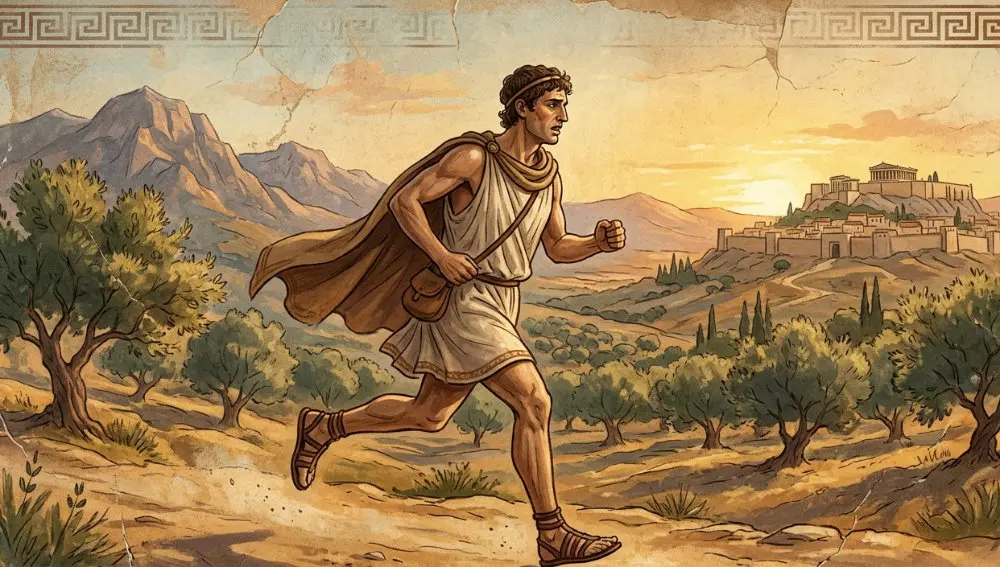
Pheidippides: The messenger who ran from Marathon to Athens to announce the Greek victory over the Persian invasion
The marathon takes its name from the legendary run of Pheidippides, a Greek messenger who supposedly ran from the battlefield of Marathon to Athens in 490 BC to deliver news of a military victory over the Persians — then collapsed and died on the spot. Historians have argued for centuries about how much of it is actually true, but the image of that exhausted messenger carrying news across the hills of Greece became the founding myth of long-distance running, and nobody was in a hurry to let the facts get in the way of a good story.
When Pierre de Coubertin revived the Olympic Games in Athens in 1896, he wanted to honour that legend with a long-distance race. The route roughly followed the supposed path of Pheidippides, covering around 24.85 miles from the town of Marathon to the Panathenaic Stadium in the city. A Greek runner named Spyridon Louis won it, becoming a national hero almost overnight, and the marathon was immediately established as the centrepiece of the modern Games.
The problem was that nobody had agreed on a fixed distance. Over the following Olympics — Paris in 1900, St. Louis in 1904, and London in 1908 — the marathon distance varied each time depending on the host city and the practicalities of the course. Runners were turning up not knowing exactly how far they'd be running. By any modern standard, it was a mess.
The 1908 Olympics and a Royal Request
The marathon at the 1908 London Games was originally planned to cover 25 miles between Windsor and the newly built Olympic stadium at White City. A tidy enough distance. Then the organising committee made a small adjustment at the request of the royal household.
They wanted the race to start within the private grounds of Windsor Castle — and popular accounts have long held that the specific starting point was chosen so that the royal children could watch from the nursery window. Whether that was the primary reason or simply a happy consequence of keeping the public away from the start, nobody has ever quite settled the matter. Either way, the route was drawn to suit the royal household, and that's what changed everything. The finish, meanwhile, was to be positioned directly in front of the royal box inside the stadium. Once the route was measured to satisfy both requirements, it came to exactly 26 miles and 385 yards. Nobody questioned it. That's what they ran.
The race itself took place on 24 July 1908, in heat that was brutal by British standards — around 25 degrees Celsius. Of the 55 runners who started, only 27 finished. But it's the finish line, not the race itself, that passed into legend.
The Marathon Finish Nobody Could Look Away From
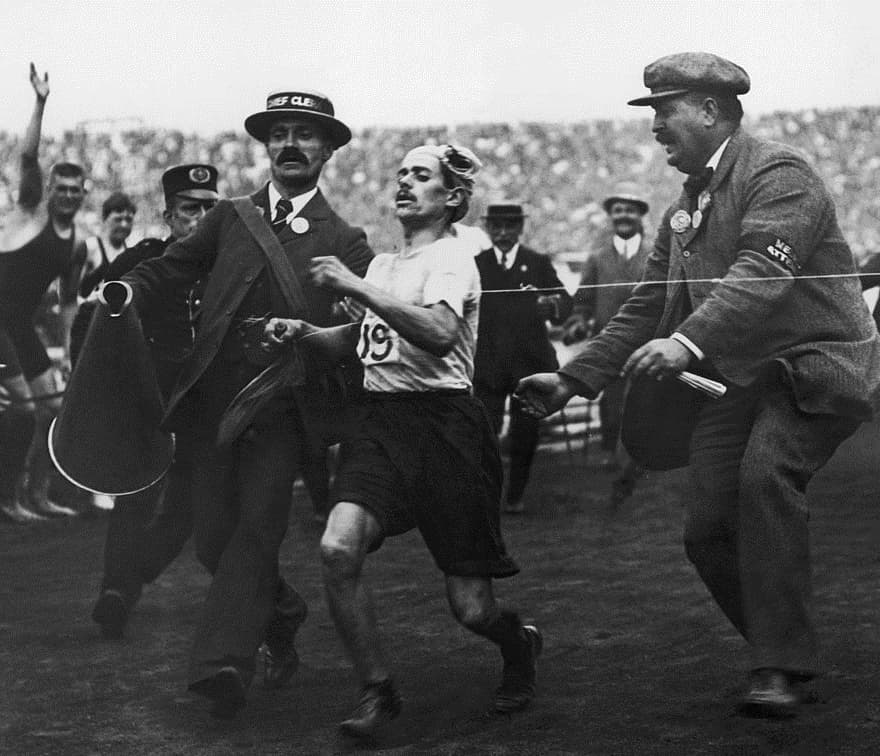
Dorando Pietri of Italy, is helped across the finish line in the Marathon event of the Olympic Games in London, 24th July 1908
An Italian pastry chef from Carpi named Dorando Pietri entered the Olympic stadium in first place, having led for the final stretch of the course. What happened next became one of the most extraordinary sequences of images in sporting history.
Pietri was in serious trouble. Whether from heat exhaustion, dehydration, or sheer physical breakdown — almost certainly all three — he staggered onto the track and immediately fell. He got up. He fell again. Officials rushed in and pulled him to his feet. He stumbled off in the wrong direction. He fell a third time, then a fourth. By the time he crossed the finish line he had fallen five times and been physically supported by race officials on multiple occasions. The crowd inside the stadium were on their feet, willing him across.
He was subsequently disqualified. The gold medal went to American runner John Hayes, who had finished behind Pietri in considerably better shape and considerably more upright. The crowd were furious. Queen Alexandra was so moved by Pietri's sheer determination that she personally presented him with a special cup as a consolation, which in the circumstances felt like the least she could do.
The photographs of Pietri — hunched, barely conscious, being held upright by officials in boater hats — were reproduced in newspapers around the world. The 1908 marathon became the race everyone talked about, and the distance it was run over quietly lodged itself in the public consciousness.
How 26.2 Became the Official Standard
The Olympics continued to use varying distances for a few more years — the 1912 Stockholm marathon was run over a slightly different measurement — but pressure was growing to settle the matter once and for all. In 1921, the International Amateur Athletic Federation formally standardised the marathon distance at 26 miles and 385 yards, exactly matching the 1908 London course.
The decision was partly pragmatic. The 1908 race had been so high-profile, so dramatic, and so widely reported that its distance had already become the de facto standard in the minds of athletes and officials alike. Formalising it was really just catching up with reality.
Every marathon run since then — Boston, New York, Chicago, Berlin, London, Tokyo — has covered exactly that distance. The six World Marathon Majors, the Olympic marathon, your local city race, the one you're currently training for — all of them trace their distance back to a route laid out to suit a royal household on a summer morning in Windsor.
The Number That Doesn't Quite Add Up
It's worth pausing on just how arbitrary this all is. 26.2 miles is not a round number in any system of measurement. It doesn't correspond to a meaningful metric distance. It has no particular physiological significance — there's nothing uniquely special about what happens to the human body at exactly that point compared to 25 or 27 miles. The wall doesn't care about the history.
The entire global standard for one of the world's most popular endurance events exists because of where a royal family wanted to sit, and where a committee decided to draw a start line.
FINAL WORD
The marathon distance isn't rooted in ancient Greek tradition or sporting science. It exists because of a nursery window at Windsor Castle, a course measured to keep a royal household comfortable, and an Italian pastry chef who refused to stay down no matter how many times the ground came up to meet him.
Every runner who lines up at a marathon start — whether it's their first or their fiftieth — is unknowingly honouring that strange chain of events. The distance you're training for, the miles you're logging, the wall you're dreading — all of it traces back to a single summer afternoon in 1908, and a route nobody ever intended to become permanent.